
Georgia Bench Warrants Explained
A Georgia bench warrant brings someone back to court. The trigger may be a missed traffic arraignment, a skipped misdemeanor date, a probation hearing, or contempt. Georgia Courts puts it plainly: a municipal missed appearance may end in a warrant and arrest. "May" is the key word. Nothing is automatic. An unpaid fine alone proves nothing. Only the docket and the order say whether payment, a new date, or another step is due. Georgia runs child-support contempt on a court path separate from a city ticket. A bench warrant returns to an existing matter. It does not open a new probable-cause case.
Note: A no-result on a sheriff page does not rule out a municipal or court-held bench warrant.
Georgia Bench Warrants Often Start Below Superior
Georgia's court system goes far beyond its felony trial court. The 2025 AOC guide to Georgia courts counts 370 Municipal Courts, 159 Magistrate Courts, 72 State Courts, and 159 Superior Courts. Those are court counts, not warrant databases. A municipal court can issue process in a local traffic or ordinance case. Magistrate and State Courts handle their own lower-court and misdemeanor matters. Superior Court handles felony trials. That spread explains why a Georgia bench warrant often begins below Superior Court. A missed city date usually stays with the municipal court that set it. Magistrate Court may keep the original warrant application. A State Court clerk holds that court's misdemeanor or traffic file. A Superior Court clerk holds its filed cases. Some matters move there after bindover. The name of a Georgia court alone does not prove it holds the current record.
| Court tier | Common bench-warrant context | First record contact |
|---|---|---|
| Municipal Court | City traffic, ordinance, or local proceeding | Municipal Court Clerk |
| Magistrate Court | Lower-court or preliminary matter | Magistrate Court Clerk |
| State Court | Misdemeanor, traffic, or State Court case | State Court Clerk |
| Superior Court | Superior case or family-support contempt | Clerk of Superior Court |
Those totals count court establishments, not public search coverage. Georgia's 159 Superior Courts sit in 51 judicial circuits. Meanwhile, each of the 370 Municipal Courts can keep its own city docket apart from a county sheriff list.
How Georgia Bench Warrants Are Issued
A Georgia citation carries a set appearance date. Skip it. The Uniform Misdemeanor Citation Manual describes a warrant to return the defendant to answer the citation and the FTA. Reasonable bond may be set for a new date. The judge and the docket control the rest. The issuing court keeps the order, while a local agency may track service. GCIC and NCIC are restricted systems, out of reach for a public Georgia bench-warrant search. City portals and sheriff lists show only their own records. A clean search page does not rule out a warrant. Bound-over cases may move from Magistrate Court to another clerk. Ask which court holds the docket. Only that court can recall its order.
Georgia’s Optional 30-Day Notice
The Uniform Misdemeanor Citation Manual describes an option. It is not a rule. A court may send first-class or postcard notice. The person then gets 30 days to resolve the matter, waive arraignment, or plead not guilty. That language belongs to the manual's citation process. It is not a statewide grace period. No single window covers every Georgia bench warrant, court date, charge, or local docket. Do not wait out a date because a notice went out in another case. A letter may never arrive. The Georgia Municipal Court FAQ says failure to appear may lead to a bench warrant and arrest, leaving local procedure to each court. The notice option never replaces checking the actual case status. Call the court named on the citation or hearing notice and ask what the judge entered.
Note: A notice period described in one citation manual is not a promise that every court will delay action.
Bench and Arrest Warrants Compared
Both orders can end in arrest, yet they start from different legal footing. A Georgia bench warrant answers a court-process default. An arrest warrant follows a probable-cause finding. That distinction tells you which file to request; see Arrest Warrant Search for the latter process.
| Feature | Bench warrant | Arrest warrant |
|---|---|---|
| Trigger | Missed appearance or failure to comply with a court order | Probable cause of an offense |
| Issuing context | Judge’s response within an existing court matter | Judicial review of sworn facts or personal knowledge |
| Primary record | Clerk of the court handling the underlying case | Issuing court, with possible later transfer |
| Typical next step | Ask about a reset, recall motion, appearance, or bond | Confirm status and discuss a planned appearance or bond |
Local labels vary. "Active" and "outstanding" are not terms from any shared Georgia code. "Recalled" means the judge withdrew the order. "Quashed" means set aside. When labels confuse, ask the clerk to explain the docket entry. Some Georgia records say "capias." But Georgia has no uniform statewide fine-collection process under that label, so ask what the specific order requires. A warrant can execute across county lines under Georgia law, yet a bench warrant still directs a return to the issuing court rather than moving the case to a different clerk.
Georgia Bench Warrants Have Separate Clerks
Every Georgia court keeps its own records, and the clerk you ask matters as much as the question. Start with the court printed on the citation or notice. If a case was bound over, the file may sit with a different clerk now, so ask which office holds it today. The court-role guide sorts out the tier, and E-Access lists participating providers, though it does not search every warrant. Sheriffs answer service questions only. They cannot reset a date or recall a bench warrant, and their list may omit a city case still pending in Municipal Court. For agency material in Georgia, request it under the Georgia Open Records Act. Court copies go to the clerk and stay subject to sealing and juvenile rules. One caution: a records request creates no statewide report and confirms nothing about live status.
Note: The Georgia court confirms its bench-warrant order, while the assigned sheriff or police agency confirms its separate service status.
Resolving a Georgia Bench Warrant
Recall sits with the issuing judge alone. That judge can quash the bench warrant, set a new date, or set bond. Georgia promises no statewide walk-through, so the court tier and the local order shape the route. Counsel can check the docket and raise a motion or planned appearance with the court.
- Use the citation, notice, case number, city, or county to identify the court that set the appearance.
- Ask the clerk whether a failure-to-appear entry and bench warrant exist, whether the order is still active, and whether the file has moved.
- Ask what options the judge allows, such as a reset request, a motion to recall, a new appearance, payment, or bond. A request is not a recall until the court grants it.
- If an in-person appearance or surrender may lead to custody, consider speaking with a Georgia defense lawyer first. Do not assume a walk-in guarantees release.
- After the court acts, get the docket entry or written order and ask which service agency needs the update.
Posting bond can secure release and a new appearance date. It does not dismiss the charge. Keep the court order and any service-unit update with the case papers in Georgia, since those records speak for you later.
Caution: A Georgia bench warrant can remain active until the issuing judge recalls it; an empty online list or an old payment receipt is not proof it cleared.
Before an In-Person Warrant Check
Georgia.gov gives a blunt warning. A person who walks in to ask about a warrant may be taken into custody if one exists. Call the court or a lawyer first. A relative's answer from another county counts for nothing in this case. Before traveling, ask the clerk whether the file is there, what identifying details to bring, and whether a judge or bond decision is needed. Georgia.gov also says a sheriff inquiry requires a first and last name plus date of birth. If a sheriff or jail handles service, confirm that office's process separately. In Georgia, a traffic FTA can also touch DDS license status. The citation court confirms release transmission; DDS confirms your own driving record. Keep the two issues apart until each office confirms its update.
Finding the Court That Issued It
Start with whatever paperwork you have. The citation, summons, bond paper, or notice should name the issuing court. City traffic and ordinance cases in Georgia usually land in Municipal Court, county preliminaries in Magistrate Court, misdemeanors and traffic in State Court, and felony trials in Superior Court. A felony warrant can start out in Magistrate Court too. Lost the papers? Hand the clerk a case or citation number plus the city or county, and Georgia court staff can work from there. The County Directory routes you to local courts and sheriffs, though each office can only confirm its own records. Child-support contempt runs through Superior Court and the assigned Division of Child Support Services caseworker, since it stands apart from a city ticket. If a case moved, ask which court now holds the docket.
Georgia Bench Warrant Portal Access
Not every Georgia warrant page is a public search. Some courts post one the public cannot use for a self-check. The Cobb Magistrate Warrant Inquiry portal requires verified Georgia State Bar membership. So a login screen does not mean you can type in a name and check your own warrant online. Cobb's portal is county-specific. It cannot show what other courts expose. Where credentials bar the public, contact the issuing clerk and ask about a public inquiry route or a record request. Cobb Magistrate Court's Warrant Division page still lists a public contact route and counter hours. Those details serve public questions even though the online query stays reserved for verified State Bar members. The official sign-in screen displays that restriction before any search begins.
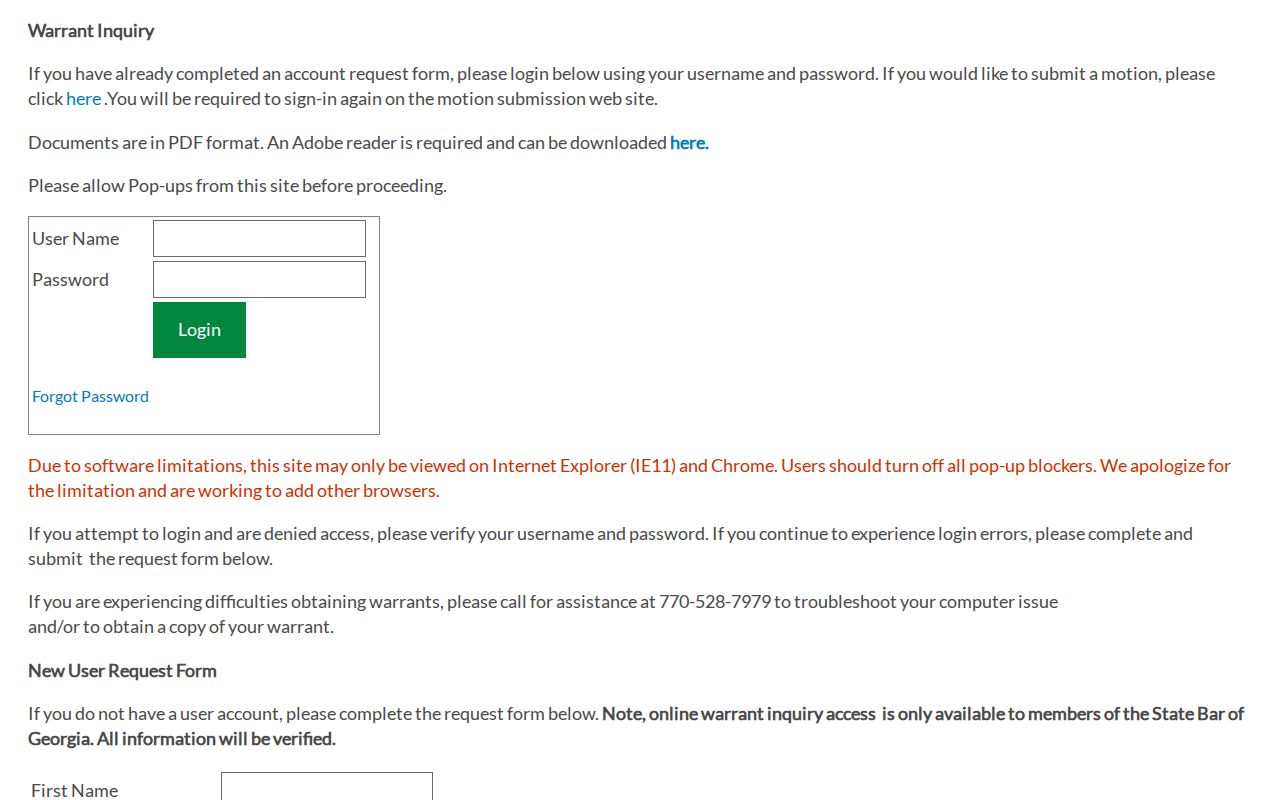
A self-check therefore still goes to the issuing court or local agency.