
Georgia Active Warrants Explained
Georgia publishes no statewide active-warrant list and no public name search. Georgia.gov's warrant instructions point people to the sheriff in the county where the matter arose, since each sheriff keeps the information for that county. Some sheriffs post a wanted page. Others answer only by phone or in person. A city court may keep its own traffic or failure-to-appear record, and no single Georgia website pulls all of these together. "Active" or "outstanding" usually just describes a local record still awaiting service, and Georgia uses no shared code list or public definition. A judge can recall an order. An officer can return it after service. A local site may lag behind either event. The issuing clerk confirms the court record, while the sheriff confirms service status, so a public listing is a starting clue rather than a final answer.
Why Georgia Has No Statewide Active-Warrant List
Georgia offers no public index with all-county filters, coverage details, or a count of open warrants. One name search cannot promise to cover Superior, State, Magistrate, and Municipal Court records, and local pages may be selective or missing. GBI runs GCIC, and authorized agencies can query state and federal wanted-person systems. The public cannot search GCIC or NCIC. Ask the sheriff and the court named on the case papers.
Note: Georgia's missing public search is not a negative warrant result; county and court records still need direct confirmation.
How Georgia Tracks Active Warrants
Georgia has no public statewide dataset, no county participation roster, and no published update schedule for warrants. GCIC and NCIC stay restricted to law enforcement, so no county feeds a public searchable list that refreshes nightly. Local practice varies instead. A sheriff may post selected entries or answer only under office policy, while the issuing court keeps its own docket. Compare the full name and date of birth, then ask the clerk or sheriff to confirm current status. A blank result can mean several things: a municipal court outside the sheriff's list, no published roster at all, a warrant just issued or recalled, slow local updating, a restricted file, or a different name spelling. Georgia publishes no statewide feed that settles those possibilities.
Note: No Georgia-wide update interval is published, so absence from any statewide or county screen is not proof that no warrant exists.
Georgia GCIC and NCIC Are Restricted Systems
GBI's Georgia Crime Information Center serves approved criminal-justice users, and NCIC is the FBI system authorized agencies use for national queries. Neither one lets the public search for a Georgia active warrant. A local sheriff or court may lean on those secure systems while still taking public confirmation at its own counter or clerk's office. GCIC criminal-history information is a different animal from a live warrant check, too. A history record covers arrests and case outcomes. It is not a current-order register. GBI offers criminal-history reports and self-record procedures, but none of those channels certify whether an order is active today. For that, go to the court that issued the process and the sheriff or officer assigned to serve it.
Inside an Active Warrant Record
Georgia has no public statewide warrant schema. Local pages pick their own fields, and the court often holds more detail. Confirm each item with the clerk, since labels vary by office.
| Warrant or case number | No statewide number format is verified. Copy the identifier as printed and ask the issuing clerk to match it to the current docket. |
|---|---|
| Name and descriptors | Some county lists show name, alias, or date of birth. Confirm identity through the court or sheriff before relying on a name match. |
| Issuing court | A local listing may omit the court. Ask the clerk where the warrant originated and whether the case later transferred. |
| Charge or reason | A public page may leave out an offense, FTA reason, or case details shown in the court file. |
| Bond or conditions | Terms are set by the order or a later court decision. Confirm the present amount and approved process with the court or jail. |
| Status or return | Active, served, recalled, or returned may be local labels. Georgia has no uniform public status-code list. |
A blank bond field does not mean release is free. "Served" does not necessarily close the case, so ask the clerk which court record controls.
Georgia Warrant Status Labels Vary
Georgia has no shared status-code list. Treat a portal term as one system's label and ask what it means today, since a later hearing, return, or recall may not appear online yet.
- Active or outstanding
- A local description that an order remains open for the system's purpose; confirm it with the issuing court.
- Served or executed
- The order has been carried out, often by arrest or service; the underlying case may still be open.
- Recalled
- The issuing judge or court has withdrawn the warrant. Ask whether the sheriff's service record has been updated.
- Returned
- The serving officer sent the process back to court, often after service or another action.
- Quashed
- A court set aside the order or process. Use the exact disposition in the Georgia docket.
Note: Ask the Georgia issuing clerk to explain an unfamiliar docket label and distinguish service status from the underlying case disposition.
Warrant Roundups and Most-Wanted Lists
GBI's Fugitives program and its partner task force publish selected fugitive information, not a search of every active warrant. Kimberly's Call covers only qualifying violent-crime cases that meet public-safety criteria. No statewide roundup or amnesty program exists. Temporary municipal events may name specific case types and dates only. Reward and tip terms vary too. Follow the official program instructions, and take a personal warrant question to the issuing court and sheriff.
Key Point: GBI pages are selected programs, not complete warrant lists. Read the official GBI page for current scope.
An unlisted name is not proof of no warrant; do not reproduce names, photographs, or roster entries.
Georgia Fugitive Pages Are Curated
GBI describes Kimberly's Call as an alert for selected violent-crime cases posing a serious public threat. It does not expose GCIC or list every warrant. The Southeast Regional Fugitive Task Force works selected cases with partner agencies. The GBI page outlines the alert process.
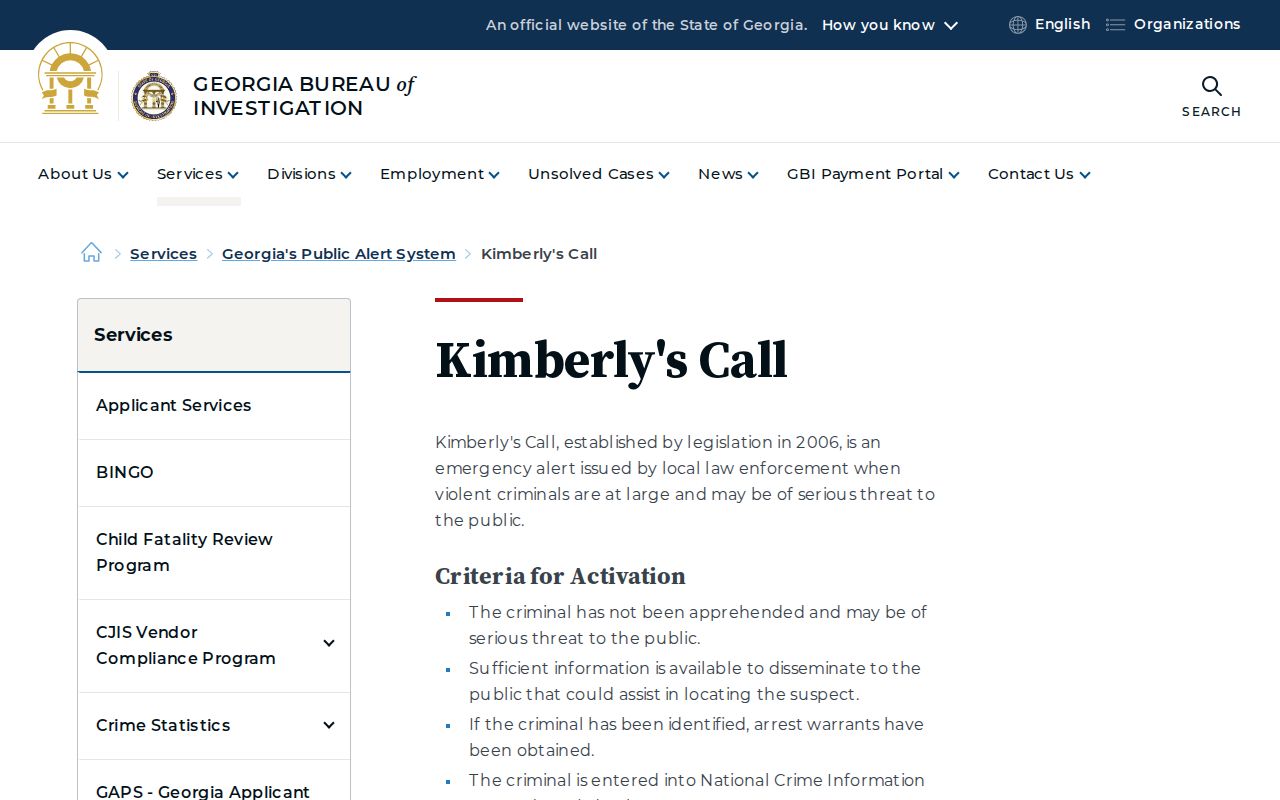
That GBI page sets program criteria, not a wanted profile. A personal warrant check belongs with the Georgia sheriff and court, not a fugitive tip channel.
Georgia Sheriff Lists Are Partial Clues
Georgia sheriffs decide for themselves whether to publish wanted lists, and what each entry includes. Towns County posts name, alias, date of birth, and an active-warrant marker, with no public search controls. The page carries clear warnings. It is not the court record, it may lag behind the docket, and it should not steer legal action. Other Georgia counties show different fields or publish nothing at all. The Towns County disclaimer spells out these limits in plain terms.
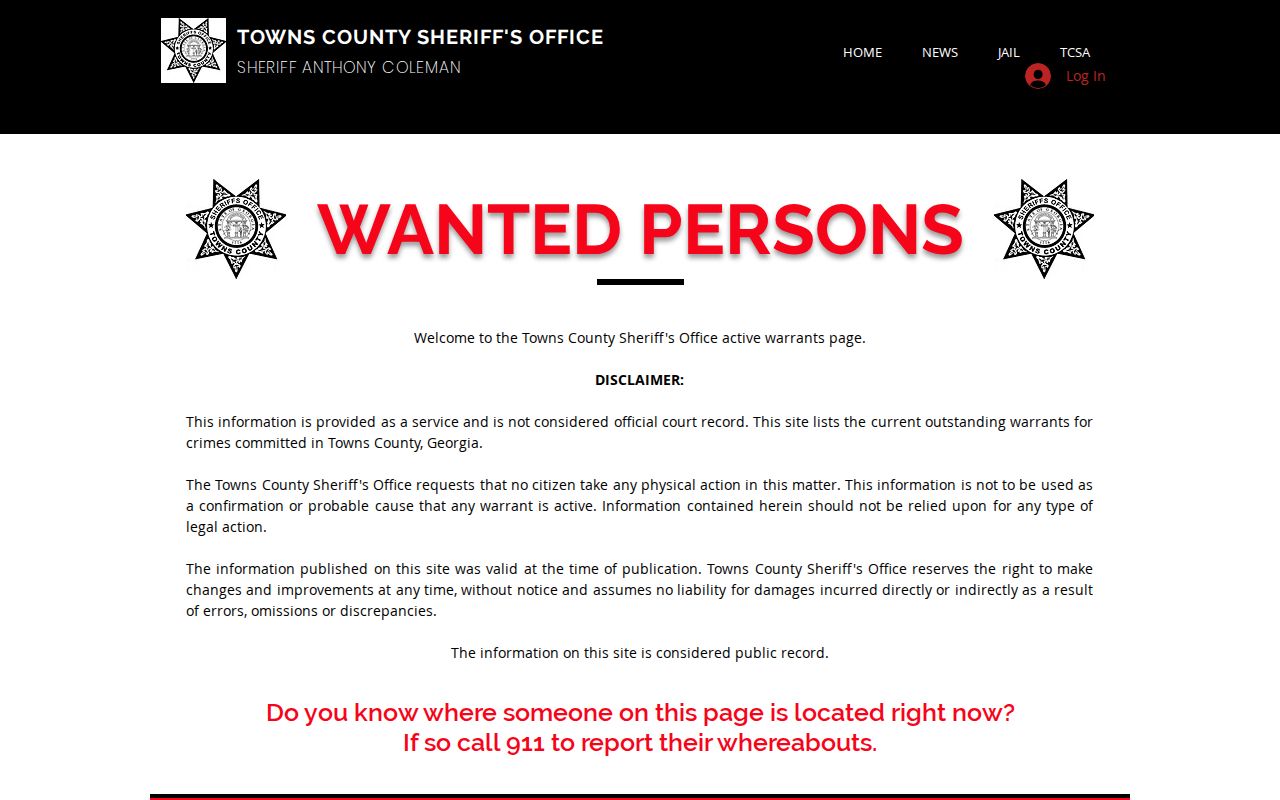
The crop shows only the heading, disclaimer, and column labels. Verify any status with the Georgia issuing clerk or agency before relying on it.
Note: A Georgia sheriff roster can help locate a contact, but only the issuing court can confirm the order's current legal status.
Fulton County's Sheriff shows how different the rules can be. The named person must appear with photo ID. No status by phone. The office reports processing more than 21,000 criminal warrants in an average year, a Fulton figure rather than a Georgia statewide count.
Georgia Warrant Records Have Access Limits
Warrant records in Georgia sit inside an open-records framework with real limits. The Georgia Open Records Act, O.C.G.A. §§50-18-70–78, covers agency records but carves out exceptions. It does not force an agency to build a new search or a combined report. Investigative and prosecution files may be withheld under O.C.G.A. §50-18-72, and juvenile records face separate restrictions under O.C.G.A. §15-11-704(a). So the practical move is to request an existing record from its custodian, naming the case, court, and date range. A response usually arrives within three business days or explains timing, cost, and any withholding basis. Fees can apply. Sealed material and protected identifiers may come back redacted or withheld entirely. Current Governor guidance exempts the first 15 minutes of search time, lists ten cents per page, and allows advance payment once an estimate reaches $500 or more. The Georgia Attorney General's Open Government FAQ walks through response timing and the exemptions that shape a public-record request.
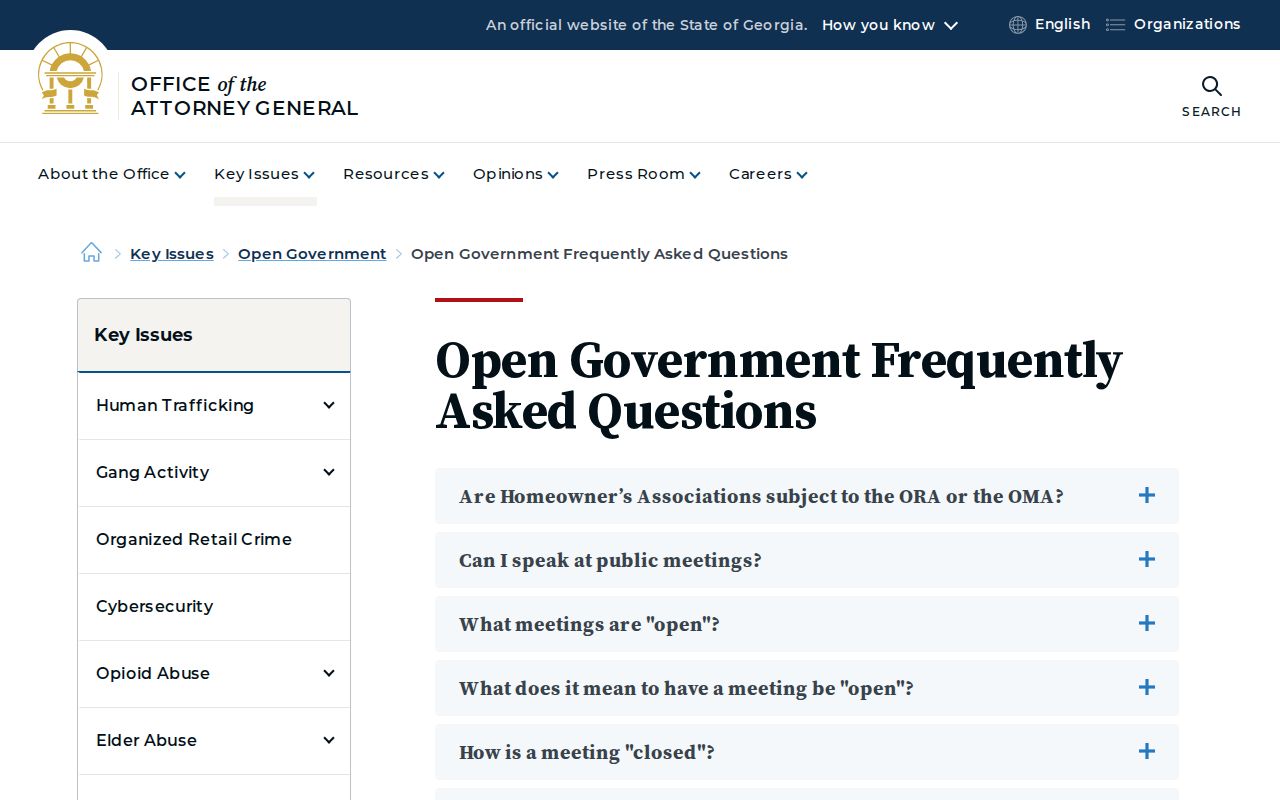
The capture shows the official FAQ, not a warrant result or live status search.
Confirm a Georgia Warrant Before Acting
Match the full name and date of birth first. Then ask the Georgia sheriff or the issuing clerk to confirm the court, case number, charge, bond, next date, and current status. For a city citation or a missed court date, call that Municipal Court even when a sheriff list shows nothing. If the file transferred, ask which clerk holds it now. Keep two cautions in mind. Paying a fine or vanishing from a list does not by itself recall a warrant, so ask the court which docket entry controls and get written confirmation of any recall or new date. If custody worries you, talk with counsel before any in-person step.
When Your Name Is on the Warrant List
Start by pinning down the Georgia county and the issuing court, using the citation, notice, or docket. The County Directory links to local confirmation. Ask what the order requires, whether bond or an appearance applies, and whether the case has moved. A selected page is never a full case history, and a name missing from one does not rule out a warrant. For GBI program details, follow its official instructions. Never approach anyone because of a posting. With a confirmed order, talk with counsel about an approved appearance, bond, motion, or surrender. Only the court can change its own order; the Most Wanted List covers curated fugitive pages.
Important: Before an in-person inquiry, consider legal advice; Georgia.gov warns that the named person may be taken into custody if a sheriff finds an active warrant.